


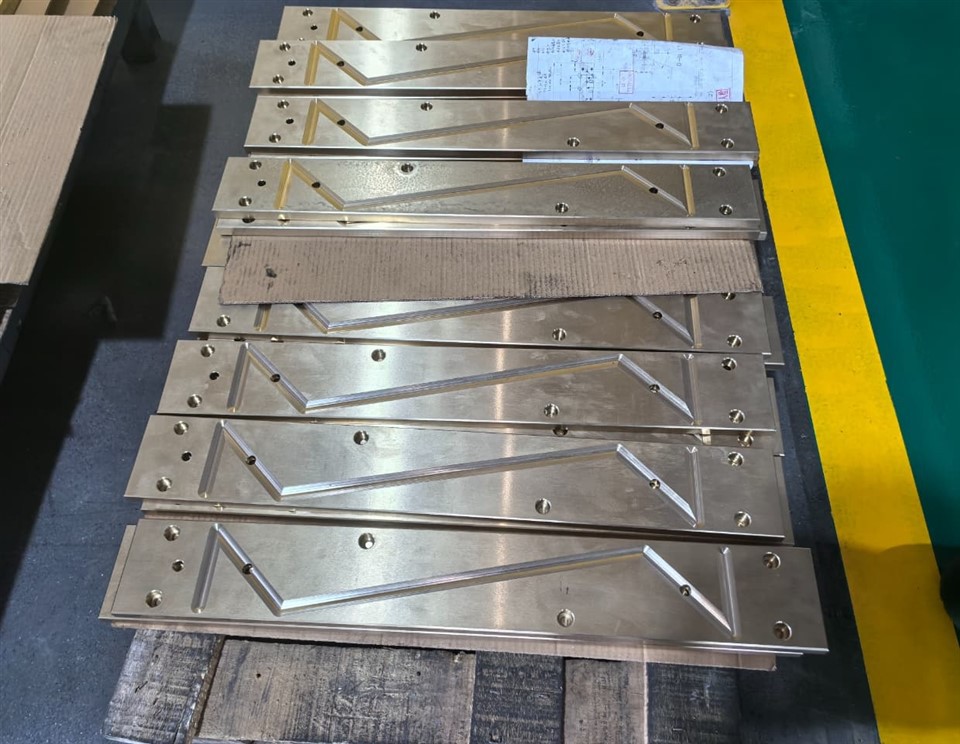


Metal Industrial Parts Precision Machining Bronze Metal Liners Plates
Bronze liners plates are critical sliding contact components that are made from copper-based bronze alloys, primarily utilized in high-load, low-to-medium speed sliding mechanisms to minimize friction, reduce wear, and protect mating components from galling and premature failure.
- Fast Delievery
- Quality Assurance
- 24/7 Customer Service
Metal Industrial Parts Precision Machining Bronze Metal Liners Plates

Bronze liners plates are critical sliding contact components that are made from copper-based bronze alloys, primarily utilized in high-load, low-to-medium speed sliding mechanisms to minimize friction, reduce wear, and protect mating components from galling and premature failure. The bronze liners include plates and bushes. Their material composition and structural design are engineered to meet various engineering requirements, including working condition temperature, loading force, lubrication conditions, and corrosion resistance.
1. Material Composition & Alloy Designations
1.1 Material Series Introduction
Different alloy compositions are designed to meet the performance requirements. The brief table below is the most commonly applied bronze alloys for liners, along with their main chemical compositions (mass fraction, %) and industry application:
|
Alloy Type |
Industry Designation (SAE/ASTM/DIN) |
Key Chemical Composition |
Primary Advantages |
|
Tin Bronze |
SAE C90700 (CuSn10P); DIN PB2 |
Cu: 87.0–90.0%, Sn: 10.0–11.5%, P: 0.5–1.0%, Impurities (Pb, Zn, Fe) ≤0.25% |
High wear resistance, excellent sliding properties, and good fatigue strength |
|
Leaded Tin Bronze |
SAE C93200 (CuSn6Zn6Pb3); SAE C93700 (CuPb20Sn5) |
C93200: Cu≈85%, Sn:6–7%, Zn:6–7%, Pb:2–3%; C93700: Cu≈75%, Pb:20%, Sn:5% |
Enhanced self-lubrication, anti-seizure, suitable for boundary lubrication |
|
Aluminum Bronze |
SAE C95400 (Nickel-Aluminum Bronze); DIN CuAl10Fe3 |
Cu≈83%, Al:9–11%, Fe:2–4%, Ni:3–5% |
High tensile/compressive strength, corrosion resistance (seawater/mild chemicals), heat resistance |
|
High-Strength Brass |
ZCuZn25Al6Fe3Mn4 |
Cu≈60%, Zn:25%, Al:6%, Fe:3%, Mn:4% |
Superior strength and toughness, suitable for heavy-load structural applications |
1.2 Characteristics of Bronze Liners.
Wear resistance and low friction: suitable for sliding, reciprocating, and rotary motions
High load capacity: compressive strength of 300~500 MPa, ideal for heavy loads
Self-lubricating: lead-containing, graphite-impregnated, or oil-impregnated structure enables oil-poor / oil-free operation
Corrosion resistance: resistant to water, oil, seawater, weak acids, and alkalis
Shock absorption, noise reduction, and anti-seizure: protects journal surfaces
Excellent thermal conductivity: fast heat dissipation, suitable for continuous operation
2. Structural Configurations & Manufacturing Processes
Bronze liners are manufactured via precision processes to ensure excellent material, dimensional accuracy, and surface quality, with common structural configurations tailored to application needs:
Sleeve Liners: Solid cylindrical sleeves (OD: 10–200 mm, ID: 8–190 mm, length: 15–500 mm), manufactured by centrifugal casting, sand casting, or extrusion, followed by turning, grinding, and honing to achieve surface roughness Ra ≤ 0.8 μm.
Plate Liners: Plate liners in various thicknesses, used in applications with surface loads; thickness: 3–200 mm. All the dimensions can be tailored.
Split Bearing Liners: Two-piece design for easy installation/removal, used in large-diameter shafts (ID > 100 mm) and heavy-load applications (e.g., steel rolling mills, engine crankshaft bearings, and hydraulic press mills, etc.).
Graphite-Inlaid Bronze Liners: Graphite plugs (3–15 mm diameter) embedded in the bronze matrix to provide self-lubrication under oil-free or low-lubrication conditions, mitigate friction and wear in harsh environments.
Steel-Backed Bronze Liners: Bimetallic structure (steel backing + bronze overlay, thickness: 0.5–2.0 mm), combining steel's high strength with bronze's tribological properties, suitable for ultra-heavy-load applications (≥500 MPa).

3. Engineering Applications & Operating Considerations
Bronze liners plates are widely used in engineering machinery, engine & automotive, aerospace, shipping & marine, and mold industries. The common applications are as follows.
Hydraulic cylinders: Piston rod liners, cylinder bore liners (C93200, B505, C93700);
Mold machinery: Guide bushings, slider wear plates (CuSn10P, B101, C90700);
Automotive/engine: Crankshaft bearings, connecting rod bearings, valve guides;
Marine equipment: Stern shaft liners, rudder bearings, seawater pump liners;
Engineering machinery: Excavator pin liners, crane boom pivot liners (high-strength brass, C95400);
Metallurgical equipment: Rolling mill bearings, continuous casting machine liners (B1032, CuAl10Fe3);
Operating considerations: Bronze liners require proper lubrication (mineral oil, grease) to maximize service life; for high-temperature or corrosive environments, aluminium bronze or corrosion-resistant tin bronze is recommended. Dimensional tolerance is typically controlled within ISO H7–H8 for inner diameter and h8–h9 for outer diameter to ensure proper fit with mating components.
Hot Tags: metal industrial parts precision machining bronze metal liners plates, China, suppliers, manufacturers, factory, customized, Polyester Wire Mesh Filter, Polyester Wire Mesh, Insulation Plate, Mesh, Heating Plate, Strippers and Troughs


